Latest News
2026/07/06
Technology-Driven Sustainable Management: ASUS Develops AIXESG Platform
-
Copied to clipboard

At COMPUTEX 2026, ASUS deepened its "Ubiquitous AI. Incredible Possibilities" strategy and unveiled a comprehensive end-to-end AI ecosystem. This ecosystem seamlessly connected enterprise-grade infrastructure with intelligent edge experiences. Spanning from its AI x ESG platform to AI infrastructure across cloud and on-premise environments, ASUS fully integrated hardware, software, and services. This empowered clients to efficiently build, deploy, and scale AI applications, driving every step of innovation with unwavering confidence.
Central to this, ASUS's sustainability strategy was rooted in the principle of " Using Digitized Data and Scientific Management Practices to Support Sustainable Value Creation through Core Competencies. " Through the strategic vision for a comprehensive sustainable digitalization platform, ASUS progressively integrated key areas such as carbon data management, supply chain management, and ESG information integration management, culminating in the establishment of the ASUS AI x ESG platform.
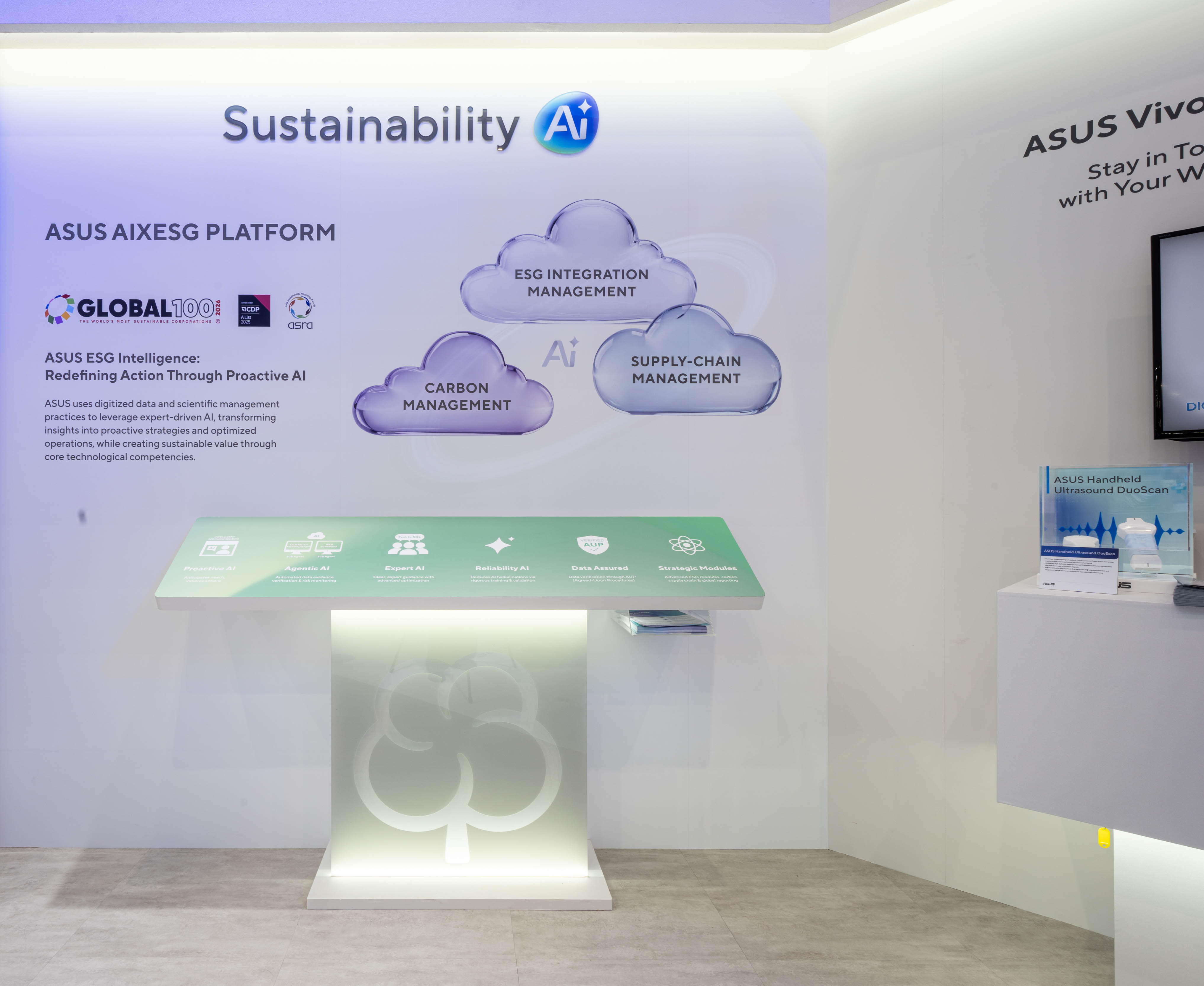
The ASUS AI x ESG platform incorporates active AI technology, guided by practical experience and data-centric strategic insights, to provide clearer and more holistic oversight for sustainability management.
This solution integrates three core ASUS platforms:
The Carbon Data Management Platform, which supports automated carbon inventory and reduction planning.
The Supply Chain Management Platform, for dynamically monitoring supplier risks and tracking improvement actions.
The ESG Information Integration Management Platform, which aggregates environmental, social, and governance (ESG) data to integrate into the core of decision-making.
Active AI assists businesses in identifying data gaps, understanding key disclosure requirements, and offering tailored recommendations, thereby making sustainability decisions more efficient and credible.
Taking the Carbon Data Management Platform as an example, ASUS's net-zero targets were set and validated according to the Science Based Targets initiative (SBTi). As the entire group moved towards net-zero, corporate management faced the following pain points: (1) Verifying the accuracy of data from over 900 suppliers and subsidiaries. (2) Increased corporate communication costs due to varying scales of subsidiaries and suppliers, and inconsistent understanding of carbon management knowledge.
Therefore, ASUS developed the Carbon Data Management Platform, which consolidates carbon data from multiple entities through its system. Beyond verifying information accuracy using AI and OCR technologies, the AI technology can also provide the most suitable carbon emission factors based on activity types, thereby reducing reporting errors from suppliers and subsidiaries and improving work efficiency. To mitigate AI hallucination, ASUS optimized the development and training of an AI Corporate Carbon Advisor by combining years of corporate sustainability management experience with RAG and prompt engineering. This advisor can provide users with answers from verified, accurate information. By adopting a human-centered design thinking approach to create user-centric features, the ASUS Carbon Data Management Platform successfully reduced AI hallucination to 0.44%, increased coefficient reporting efficiency by 50%, reduced third-party verification time by 30%, and halved coaching costs for subsidiaries and suppliers.
Continuing its goal of leveraging AI to assist in sustainability management, enhance work efficiency, and transform processes, ASUS has developed a Supply Chain Management Platform. This platform features an AI risk engine functionality that monitors global news, regulations, NGO reports, and other dynamics in real-time. It uses AI to help identify non-compliant items, recommend audit targets and customized audit items, and assist managers in formulating improvement measures and tracking plans.
Finally, regarding transparent disclosure and information integration: In the future, through ASUS's ESG Information Integration Management Platform, AI will proactively guide users. This will enable them to complete cross-sustainability indicator data integration and collection, materiality analysis, disclosure gap analysis, AI-assisted drafting, and multi-language translation across various reporting frameworks, all based on AI's proactive instructions. This aims to create high-quality sustainability reports to meet increasingly complex sustainability disclosure requirements.
Guided by its operating philosophy to 'be among the world-class green high-tech leaders and to provide valuable contributions to humanity', ASUS intertwines its core operational capabilities with sustainability management. In the future, the company will continue to leverage digital enablement to create innovative value for ESG."
Related Article